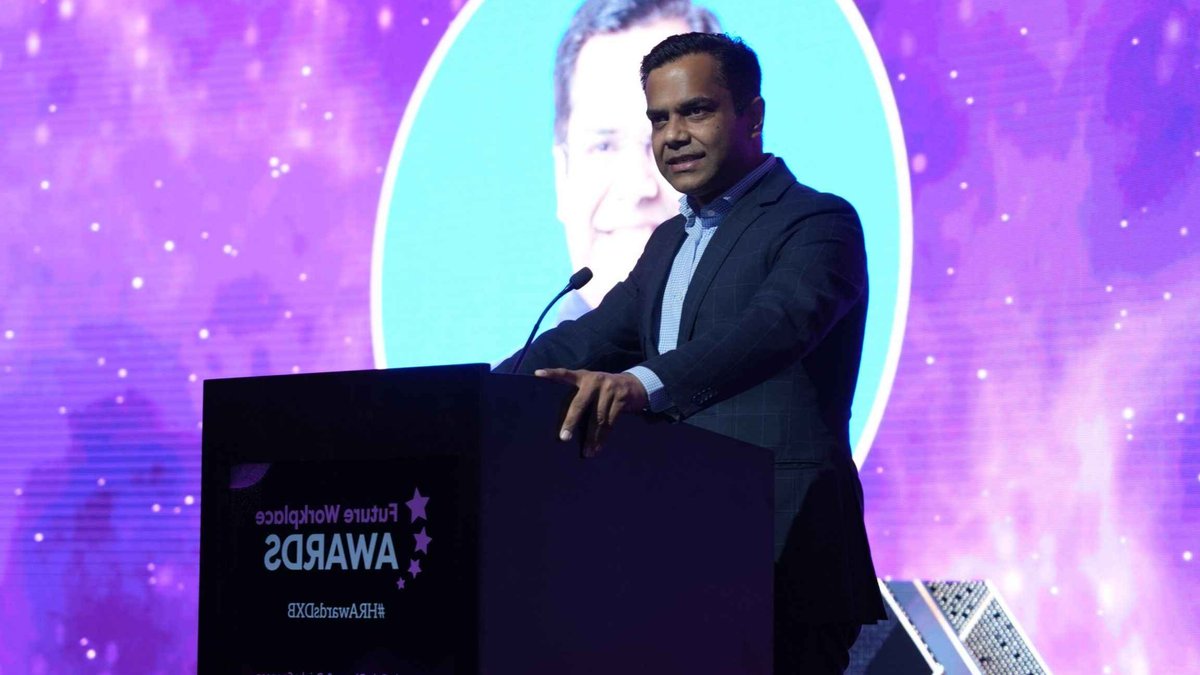
Artificial intelligence is redefining human resources functions worldwide, with AI adoption steadily increasing in the Middle East as companies recognize its transformative impact on talent management and employee engagement. PeopleStrong, Asia’s leading HR Tech company, is leading this evolution.
At the recent HR Summit & Expo held on Oct. 23-24 at the DWTC in Dubai, Mrigank Tripathi, President – Growth at PeopleStrong, delivered a keynote titled “HR Trends in the Middle East: How AI Will Be a Force Multiplier.” He explored how organisations are addressing both local and global challenges, prompting a complete rethink of talent management strategies.
Employee Trends: Expectations and Technological Shifts
Gen Z and Millennials are driving significant changes in workplace expectations. According to Mrigank, “25% of Gen Z regard work-life balance as the number one reason to choose an organisation.” This generation prioritizes flexibility, control, and well-being, with many seeking “side hustles” and alternative work arrangements.
Notably, 45% of Gen Z and 36% of Millennials have side hustles or participate in the gig economy, and many even choose gap years or delayed entry into the workforce. To engage this generation fully, companies are beginning to shift away from traditional skill-building towards a holistic approach that considers mind, body, and soul.
Mrigank explained, “Earlier, it used to be about upskilling on a particular skill. Now, the focus is on engaging the person on all three levels, mind, body, and soul, to create meaningful engagement,” he explained, signaling a more personalised and supportive employee experience.
Employer Trends: AI-Powered Solutions for Talent and Skill Management
For employers, the approach to talent management is also undergoing a transformation, particularly with skill-based talent management coming to the forefront. Companies are revamping employee experience starting from the hiring stage, prioritising candidates’ skill sets over traditional job titles.
This shift allows organisations to personalise the employee experience by leveraging AI tools to recommend tailored upskilling opportunities and facilitate continuous learning. Mrigank pointed out, “An AI-driven system can help people look at courses to upskill and even provide career buddies to guide them,” which adds a level of personalisation to career development.
Read Also: Dubizzle’s Intern Program Turns 91 Percent of Hires into Staff
AI-driven talent platforms offer visibility into available roles and growth paths, empowering employees to choose their career trajectories based on transparent, data-informed insights. However, the pace of AI adoption is a double-edged sword. PeopleStrong’s primary data reveals that 56% of HR leaders feel AI transformation is happening too fast, making it difficult for them to keep up.
Mrigank emphasised the importance of taking a practical approach, saying, “We at PeopleStrong have been working with AI for a long time, but instead of changing the world, we aim to go back to our customers and meet their needs.” One of the most significant shifts that AI brings to HR is through AI agents, AI entities that can autonomously handle specific tasks.
Unlike AI copilots that require human direction, agents operate independently, enabling them to perform tasks like drafting job descriptions or assessing candidates without human intervention. Mrigank described AI agents as “a force multiplier,” adding substantial efficiency to recruiting processes.
For example, in recruitment, AI agents can screen resumes and recommend candidates for further assessment, freeing recruiters to focus on high-value activities. Embedding AI into the entire talent management spectrum, from acquisition to development, opens up new possibilities for HR departments, he explains.
As Mrigank noted, the key to successful AI adoption is to understand that every organisation is unique, and AI solutions must be tailored to meet specific needs. With PeopleStrong continuing to refine its AI solutions, it is clear that AI has the potential to significantly boost productivity, engagement, and employee satisfaction in the Middle East and beyond.
The convergence of AI and HR in the Middle East offers immense possibilities, especially as both employees and employers adjust to shifting expectations and technological advancements. As PeopleStrong’s work demonstrates, AI is a transformative force capable of addressing the evolving needs of today’s workforce while enhancing operational efficiency, with 75% of employees already using AI in some aspects of their work.
Implementing AI Solutions in HR
The successful implementation of AI solutions in HR requires a thorough understanding of the technology and its potential applications. PeopleStrong’s expertise in AI-driven HR solutions has enabled the company to develop tailored approaches for its clients, addressing their specific needs and challenges. By leveraging AI, companies can enhance the employee experience, improve productivity, and drive business growth.
